 この記事は英語と日本語の両方で掲載されています。
On This Page
If you are preparing for the Versant English Test, it is natural to want to see your score improve quickly.
You may practise every day, complete practice tests, study vocabulary, work on pronunciation, and spend hours listening to English. But if your score does not immediately move in the direction you expected, it can be frustrating.
There is an important point to understand:
Improving your English and improving your performance on an English test are related, but they are not exactly the same thing.
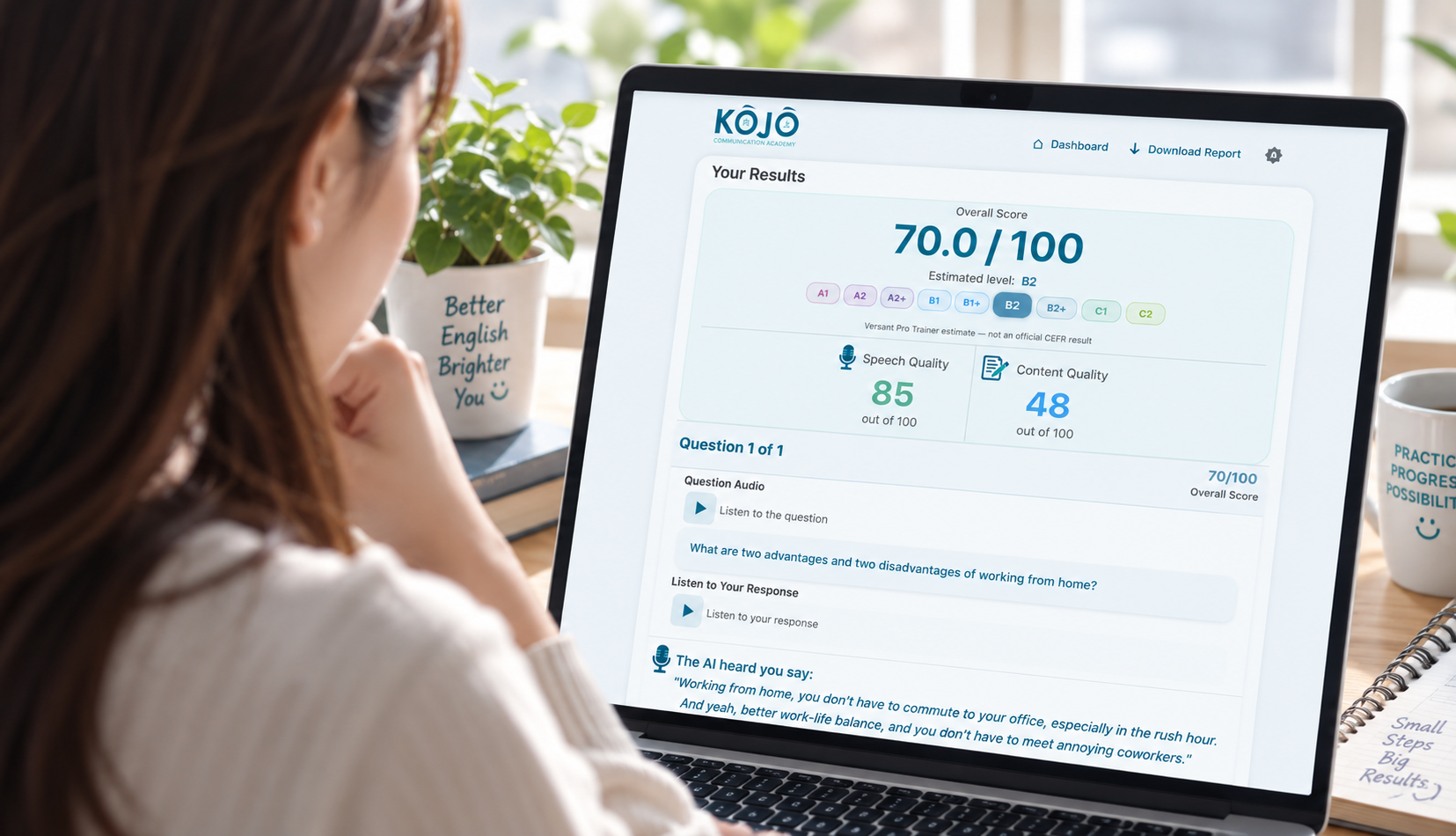
Versant Pro Trainer can be a powerful tool for practising the skills measured by the Versant test. It can help you understand the test format, identify weaknesses, practise specific skills, and track your performance.
But it works best as one part of a broader English-learning programme, rather than as your entire English-learning programme.
Test preparation is not the same as learning English
 Test preparation is not the same as learning English
There are two things happening when you prepare for a language test.
The first is developing your underlying English ability.
Developing your English
- understanding spoken English
- building vocabulary
- improving grammar
- developing pronunciation
- becoming more fluent
- understanding longer and more complex language
- expressing your ideas spontaneously
- becoming comfortable communicating with other people
Demonstrating it on the test
 Demonstrating it on the test
- respond quickly to different question types
- organise your answers
- retain important information
- use effective strategies for different parts of the test
- manage your time
- recognise your recurring mistakes
- become familiar with the test format
Both are valuable.
But practising the test itself cannot replace the broader process of developing your English. Our Versant preparation guide covers the test-specific side in more detail, and the Part A to F guides look at each question type individually.
More study does not always mean more progress
 More study does not always mean more progress
It is tempting to think that if 30 minutes of practice is useful, three hours must be six times better.
Language learning does not always work that way.
The quality, balance and effectiveness of your practice matter.
For example, a learner might spend a lot of time studying English but do almost all of their practice in one way:
- memorising phrases
- shadowing English audio
- watching an English programme
- studying vocabulary
- completing test questions
- repeating the same type of exercise
All of these can be useful.
The problem comes when one activity becomes almost the entire learning programme.
Learning a second language is a complex process. You need to understand English, but you also need to retrieve language, formulate your own thoughts, respond to other people and communicate without having everything prepared in advance.
A balanced programme gives you opportunities to develop different parts of that ability.
Real communication matters
 Real communication matters
One of the most important parts of learning to speak English is learning to think and respond in real time.
In a real conversation, you do not normally know exactly what the other person will say.
You have to:
- understand what you hear
- decide what you want to say
- find the words and grammar
- organise your thoughts
- say them clearly
- respond to the other person's reaction
This is very different from simply repeating a sentence that you have already heard.
That is why spontaneous speaking practice is an important part of an effective English-learning programme.
Conversation with a teacher, colleague, friend or other English speaker can be extremely valuable. AI conversation tools can also provide additional opportunities to practise responding spontaneously when regular human conversation is difficult to arrange.
The goal is not simply to know more English.
The goal is to be able to use the English you know.
So where does Versant Pro Trainer fit?
 So where does Versant Pro Trainer fit?
This is where a focused practice tool can be extremely useful.
Versant Pro Trainer gives you a structured environment in which you can practise the skills required by the test.
You can use it to:
- become familiar with the different question types
- practise listening and speaking under test conditions
- identify specific weaknesses
- work on pronunciation and fluency
- develop strategies for different parts of the test
- receive feedback
- monitor your performance over time
A coach can add another layer by looking at your performance across different tasks and helping you decide what to work on next.
For some learners, test-focused practice may be a relatively large part of their programme, particularly when an important test date is approaching.
For others, the priority may be broader English development, with Versant practice used alongside it.
The right balance depends on your current English level, your target, your timeline and how much English you use outside your study sessions.
What does a balanced programme look like?
 What does a balanced programme look like?
There is no single perfect schedule.
For example, a learner with plenty of available time might have a week that includes:
Build English
Grammar, vocabulary, listening
Communicate
Conversation, spontaneous speaking

Practise the test
Versant Pro Trainer, focused practice
Review and adjust
Feedback, reflection, next priority
A very busy learner might use shorter sessions:
- 10 minutes of vocabulary or grammar
- 10 minutes of listening
- 10 minutes of spontaneous speaking
- a few focused Versant practice sessions during the week
The sessions do not have to be long to be useful.
The important thing is that the different activities work together.
If regular human conversation is difficult to arrange, AI conversation practice can provide additional speaking opportunities. It should complement other learning activities rather than replace everything else.
How long does it take to improve your English?
 How long does it take to improve your English?
There is no universal answer.
Some learners progress quickly. Others need considerably more time. Your previous experience, current level, study intensity, opportunities to use English and many other factors can affect your progress.
Cambridge English says that it takes approximately 200 guided learning hours for a language learner to progress from one CEFR level to the next, while noting that language-learning background, study intensity, age and exposure outside lessons can affect the time required.
Its indicative cumulative figures from beginner level are approximately:
| CEFR level | Guided learning hours |
|---|---|
| A1 | 90-100 |
| A2 | 180-200 |
| B1 | 350-400 |
| B2 | 500-600 |
| C1 | 700-800 |
| C2 | 1,000-1,200 |
Source: Cambridge English: Guided learning hours. Indicative cumulative figures from beginner level.
These numbers should not be interpreted as a timetable.
They do not mean that you need exactly 200 hours before you will notice any improvement. You can make useful progress much sooner.
They do, however, provide some perspective on the scale of language learning.
Substantial changes in overall English proficiency are normally a longer-term process.
A test score is a measurement, not your entire learning journey
 A test score is a measurement, not your entire learning journey
It is also important not to overinterpret individual test results.
A test score tells you how you performed on a particular test at a particular point in time.
Your underlying English ability develops over a much longer period.
That means a higher score does not necessarily mean that your overall CEFR level has suddenly changed. Equally, a lower score does not necessarily mean that your English has suddenly become worse.
Scores can move up and down.
That is why it can be more useful to look at patterns over time, together with the specific skills behind your performance. If you want a concrete example of what one realistic improvement journey can look like, our article on moving from the 30s to 59 breaks down the stages honestly.
- Are you understanding more?
- Can you respond more quickly?
- Are you making fewer recurring errors?
- Can you explain your ideas more clearly?
- Are you more comfortable speaking without preparation?
- Can you retain and communicate important information more accurately?
These are meaningful signs of development, even when a particular test score does not immediately reflect them. For a deeper look at what the numbers themselves mean, see the Versant score guide and our CEFR benchmarks.
Your target score also needs to be considered in context
The size of a score increase can sometimes look smaller than it really is.
Versant uses a 10-90 score scale. A few points on that scale may represent a meaningful change in performance, particularly when a learner is already operating within a relatively narrow range.
More importantly, the difficulty of reaching a particular target depends on where you are starting from and what underlying English skills you already have.
A learner who needs to improve their English by a substantial CEFR level may need a broader and longer-term programme.
A learner who already has the necessary underlying ability may benefit more from focused test preparation and targeted practice.
The right question is not simply: "How many points can I gain?"
A better question is:
"What skills do I need to develop in order to achieve that score, and what is the most effective way to develop them?"
Once you understand that, your practice becomes much more purposeful.
A simple self-check
 A simple self-check
Before deciding how much Versant practice you need, ask yourself:
Can I communicate spontaneously?
Can you answer unexpected questions in English without translating every sentence in your head?
How much English do I use outside test practice?
Do you regularly listen, read, speak and communicate in English?
Is my practice balanced?
Are you developing vocabulary, grammar, listening, pronunciation, fluency and spontaneous speaking, or concentrating almost entirely on one activity?
Do I understand my weaknesses?
Do you know why you are losing points, or are you simply completing more practice tests?
Is my target realistic for my current level and timeline?
A target score can be useful and motivating. But the amount of time available and your current English ability also need to be considered.
What will I do outside my test preparation?
This may be the most important question of all. Versant practice can be part of your programme. It should not necessarily be the whole programme.
The bigger picture
 The bigger picture
Improving your English takes time, but that does not mean you have to wait months before seeing progress. Every learner is different, and the right approach depends on your current level, your goals, your available time and how much opportunity you have to use English.
The important thing is to understand what you are trying to improve and choose your practice accordingly.
A Versant score is one measure of your English performance. It is not the whole picture.
Use Versant Pro Trainer to understand the test, practise the skills it measures and identify areas where you can improve. At the same time, continue developing your English through listening, speaking, communication and other forms of study.
If you approach your learning this way, your Versant preparation becomes part of a much bigger goal: becoming a more confident and capable English communicator.
That is the progress that matters long after the test is over.
Versant完全攻略への道
 Versant完全攻略への道
 スコアを理解する
 アプリで練習する
Want help deciding what to work on next?
A 30-minute diagnostic coaching session looks at your current performance across different task types and helps you decide which skills to prioritise. It cannot promise a particular score, but it can make your next steps much clearer.
- グラント・プレンティス(Kōjō Communication Academy 代表)
英語力を伸ばしながらVersantスコアを上げるには?
 英語力を伸ばしながらVersantスコアを上げるには?
Versant English Testの受験を考えているなら、できるだけ早くスコアを上げたいと思うのは当然です。
毎日練習する。模擬問題に取り組む。語彙を覚える。発音を練習する。英語をたくさん聞く。
それでも、思ったようにスコアが上がらないと、「これだけやっているのに、なぜ?」と感じることがあるかもしれません。
ここで、ひとつ大切なことがあります。
英語力を伸ばすことと、英語テストでより高いパフォーマンスを発揮することは、関係していますが、まったく同じことではありません。
Versant Pro Trainerは、Versantで測定されるスキルを練習するための強力なツールです。テスト形式を理解し、自分の弱点を見つけ、特定のスキルを練習し、パフォーマンスの変化を確認することができます。
ただし、最も効果的なのは、Versant Pro Trainerを英語学習全体の一部として使うことです。アプリでの練習だけを英語学習のすべてにする必要はありません。
テスト対策と英語力の向上は同じではありません
英語テストの準備をするときには、大きく分けて2つのことが関係しています。
ひとつは、英語そのものの力を伸ばすことです。
英語そのものの力
- 英語を聞いて理解する力
- 語彙力
- 文法力
- 発音
- 流暢さ
- より長く複雑な英語を理解する力
- 自分の考えをその場で英語にする力
- 相手と英語でコミュニケーションする力
テストで力を発揮する方法
- 問題のタイプに応じて素早く答える
- 回答を整理する
- 聞いた情報の重要な部分を保持する
- 各パートに適した方法で答える
- 時間内に回答する
- 繰り返し起きるミスを把握する
- テスト形式に慣れる
どちらも大切です。
ただ、テストの練習だけで、英語力そのものを伸ばすプロセスのすべてを置き換えることはできません。テスト対策の具体的な方法はVersant準備ガイド、各パートの詳細はPart A〜Fの攻略ガイドで解説しています。
勉強時間を増やせば、必ず同じ割合で伸びるわけではありません
30分の練習が役に立つなら、3時間やれば6倍の効果がある。
そう考えたくなるかもしれません。
しかし、語学学習は必ずしもそう単純ではありません。
どれだけ勉強するかだけでなく、何を、どのように、どのくらいバランスよく練習するかが重要です。
例えば、英語をたくさん勉強していても、そのほとんどが同じタイプの学習ということがあります。
- フレーズを暗記する
- 英語音声をシャドーイングする
- 英語番組を見る
- 単語を覚える
- テスト問題を解く
- 同じタイプの練習を繰り返す
どれも有効な学習方法です。
問題は、ひとつの方法が英語学習のほぼすべてになってしまうことです。
第二言語を身につけることは、複雑なプロセスです。英語を理解するだけでなく、知っている言葉をすぐに取り出し、自分の考えをまとめ、相手の発言に応じて、その場で英語を使う力も必要になります。
だからこそ、さまざまな力を伸ばせるバランスのよい学習が大切です。
実際のコミュニケーションが重要な理由
英語を話せるようになるために重要なのが、その場で考えて英語で反応する力です。
実際の会話では、相手が次に何を言うかを完全に予測することはできません。
聞いた内容を理解し、
- 何を言いたいのか考える
- 必要な単語や文法を取り出す
- 考えを整理する
- 英語としてまとめる
- 相手に伝わるように話す
- 相手の反応に応じて次の発言を考える
必要があります。
これは、すでに聞いたことのある英文を繰り返すだけの練習とは大きく異なります。
そのため、英語学習では、準備された英文だけでなく、即興で話す練習も重要になります。
先生、同僚、友人などとの会話は、とても有効な練習になります。
また、定期的に人と英語で話す機会を作るのが難しい場合は、AIとの会話練習を追加することもできます。
大切なのは、単に英語を「知っている」ことではありません。
知っている英語を、実際に使えることです。
では、Versant Pro Trainerはどこに入るのでしょうか?
ここで、目的を絞った練習ツールが役立ちます。
Versant Pro Trainerでは、Versantで求められるスキルを、体系的に練習できます。
例えば、
- 各問題タイプに慣れる
- 本番に近い形でリスニングとスピーキングを練習する
- 自分の弱点を見つける
- 発音や流暢さを練習する
- 各パートに合った戦略を身につける
- フィードバックを確認する
- パフォーマンスの変化を追う
といったことができます。
さらにコーチングを利用すれば、さまざまな問題への回答を見ながら、次に何を練習すべきかを一緒に考えることもできます。
試験日が近い場合は、テスト対策を学習の大きな部分にすることが適切なケースもあります。
一方で、英語力そのものの向上を優先しながら、その一部としてVersant対策を行う方が適しているケースもあります。
どちらがよいかは、現在の英語力、目標スコア、試験までの期間、そして普段どのくらい英語を使っているかによって変わります。
バランスのよい英語学習とは?
全員に当てはまる「完璧な学習スケジュール」があるわけではありません。
例えば、比較的時間に余裕がある人なら、次のような組み合わせが考えられます。
基礎的な英語学習
文法、語彙、リスニング、リーディング
実際のコミュニケーション
会話、即興でのスピーキング
目的を絞った練習
Versant Pro Trainerなどを使った練習
フィードバックと振り返り
繰り返しの問題を確認し、次の練習を決める
忙しくてまとまった時間を取れない場合は、もっと短い時間でも構いません。
例えば、
- 10分:単語や文法
- 10分:リスニング
- 10分:即興で話す練習
- 週に数回:Versantの目的別練習
という形でもできます。
1回の学習時間が長くなければ意味がない、ということではありません。
大切なのは、それぞれの学習がつながっていることです。
人と英語で話す機会が少ない場合は、AIとの会話練習を追加することもできます。ただし、AIだけですべてを置き換えるのではなく、他の学習方法と組み合わせて使うのがよいでしょう。
良い学習教材も、それだけですべてをカバーする必要はありません
 良い学習教材も、それだけですべてをカバーする必要はありません
日本には、英語を学ぶためのさまざまな教材やサービスがあります。
NHKの英語学習番組も、その一例です。
現在のNHKの英語学習ラインナップには、文法や語彙、英語を素早く話す練習、リスニングや多読、ビジネス英語、実用的な英語など、さまざまな目的の番組があります。
これは重要なポイントです。
毎日の英語番組は、英語学習の中でとても良い習慣になります。
ただ、それだけを英語学習のすべてにする必要はありません。
Versant Pro Trainerについても同じです。
ひとつの優れた学習ツールは、それだけで英語学習のすべてになる必要はありません。
英語力を伸ばすには、どのくらい時間がかかる?
これに、全員に共通する答えはありません。
比較的早く上達する人もいれば、もっと時間が必要な人もいます。
これまでの学習経験、現在のレベル、学習の頻度、英語に触れる量、実際に英語を使う機会など、さまざまな要因が関係します。
Cambridge Englishは、CEFRのレベルをひとつ上げるために必要な学習時間について、ひとつの目安を示しています。
Cambridgeによると、あるCEFRレベルから次のレベルに進むには、約200時間の指導を伴う学習時間がひとつの目安になります。
ただし、これは保証された時間ではありません。学習経験、学習の強度、年齢、授業以外での学習や英語への接触量などによって、必要な時間は変わります。
初心者からの累積時間の目安は、おおよそ次のようになっています。
| CEFRレベル | 指導を伴う学習時間の目安 |
|---|---|
| A1 | 90〜100時間 |
| A2 | 180〜200時間 |
| B1 | 350〜400時間 |
| B2 | 500〜600時間 |
| C1 | 700〜800時間 |
| C2 | 1,000〜1,200時間 |
出典: Cambridge English: Guided learning hours。初心者からの累積時間の目安。
もちろん、これは「200時間勉強しなければ、まったく上達しない」という意味ではありません。
もっと早い段階でも、実感できる変化はあります。
ただ、英語力そのものを大きく変えていくには、ある程度の時間が必要だということを理解するための、ひとつの目安にはなります。
英語力を大きく伸ばすことは、基本的には短期間だけで完結するものではありません。
テストのスコアは、学習のすべてではありません
ひとつひとつのテスト結果を必要以上に大きく捉えないことも大切です。
テストスコアは、ある時点で、あるテストを受けたときのパフォーマンスを示すものです。
一方、英語力そのものは、もっと長い時間をかけて変化していきます。
そのため、スコアが上がったからといって、その瞬間にCEFRレベル全体が変わったとは限りません。
逆に、スコアが下がったからといって、英語力そのものが急に下がったとは限りません。
スコアには上下があります。
だからこそ、ひとつの数字だけを見るのではなく、時間の経過による傾向と、その背景にあるスキルを見ることが重要です。具体的な改善プロセスの例として、30点台から59点までの記事も参考にしてください。
- 以前より多く聞き取れるようになっていますか?
- 以前より素早く答えられるようになっていますか?
- 同じミスを繰り返すことが減っていますか?
- 自分の考えをより明確に説明できるようになっていますか?
- 準備していない質問にも、以前より自然に答えられますか?
- 聞いた重要な情報を、より正確に伝えられるようになっていますか?
こうした変化も、英語力が伸びていることを示す大切なサインです。スコアの意味について詳しくはVersantスコア完全ガイドとCEFRスコア目安をご覧ください。
目標スコアも、現在の英語力との関係で考える
スコアの数字だけを見ると、数ポイントの変化が小さく感じられることがあります。
Versantのスコアは10〜90の範囲です。そのため、すでにある程度のスコア帯にいる学習者にとっては、数ポイントの変化でも意味のあるパフォーマンスの変化を示す場合があります。
そして、目標スコアに到達する難しさは、現在どこにいるか、そしてその目標に必要な英語力をすでにどの程度持っているかによって変わります。
CEFRレベルを大きく上げる必要がある場合は、より幅広く、長期的な英語学習が必要になることがあります。
一方、必要な英語力をすでにある程度身につけている場合は、テスト形式への慣れや、特定の弱点を集中的に練習することがより効果的な場合もあります。
大切なのは、「何点上げられるか」だけを考えることではありません。
それよりも、
「そのスコアを達成するために、どのスキルを伸ばす必要があるのか。そして、それを伸ばすために最も効果的な方法は何なのか?」
と考えてみてください。
そうすると、毎日の練習がより明確な目的を持ったものになります。
簡単なセルフチェック
自分に必要なVersant対策の量を考える前に、次の質問をしてみてください。
即興でコミュニケーションできますか?
予想していなかった質問をされても、頭の中ですべて日本語に訳してからではなく、英語で答えられますか?
テスト以外でどのくらい英語を使っていますか?
普段から英語を聞いたり、読んだり、話したり、コミュニケーションに使ったりしていますか?
学習内容はバランスが取れていますか?
語彙、文法、リスニング、発音、流暢さ、即興で話す力などを伸ばしていますか?それとも、ほとんどひとつの方法だけに集中していませんか?
自分の弱点を理解していますか?
なぜスコアを落としているのか分かっていますか?それとも、ただ練習問題の数を増やしているだけになっていませんか?
現在の英語力と期限を考えたとき、その目標は現実的ですか?
目標スコアを持つことは、学習の方向性を決めるうえで役立ちます。ただし、現在の英語力と、そこから目標までに使える時間も一緒に考える必要があります。
テスト対策以外に、何をしますか?
これは、おそらく最も重要な質問です。Versantの練習は、英語学習プログラムの一部として活用できます。必ずしも、英語学習のすべてにする必要はありません。
大切なのは、全体を見ること
英語力を伸ばすには時間がかかります。
だからといって、数か月待たなければ何の変化も感じられないということではありません。
学習者によって、現在のレベルも、目標も、使える時間も、英語を使う機会も違います。
大切なのは、自分が何を伸ばしたいのかを理解し、それに合わせて学習方法を選ぶことです。
Versantのスコアは、英語力を測るひとつの指標です。それがすべてではありません。
Versant Pro Trainerを使ってテストを理解し、必要なスキルを練習し、自分の改善ポイントを見つけてください。
同時に、リスニング、スピーキング、実際のコミュニケーションなどを通して、英語そのものも伸ばしていきましょう。
そうすれば、Versant対策は単なるテストのための練習ではなく、より自信を持って英語でコミュニケーションできるようになるための学習の一部になります。
テストが終わったあとにも残る英語力。それこそが、本当に大切な進歩ではないでしょうか。
次に何を練習すべきか、一緒に考えませんか?
30分の個別診断・コーチングでは、さまざまな問題タイプでの現在のパフォーマンスを確認し、どのスキルを優先すべきかを整理します。特定のスコアをお約束するものではありませんが、次の一歩をはっきりさせるお手伝いができます。
- グラント・プレンティス(Kōjō Communication Academy 代表)

グラント・プレンティス
Kōjōコミュニケーションアカデミー 代表
英語指導25年以上、Versant対策8年(2026年時点)の経験をもつ英国出身のネイティブスピーカー。構造化された証拠ベースのトレーニングを通じて、これまで何千人ものプロフェッショナルがコミュニケーションスキルを向上させ、キャリア目標を達成するのをサポートしてきました。
English version available、この記事は英語でもお読みいただけます
Read in English →